Your Brain Used to Be a Phone Book. Now It Can't Remember Its Own Number
The Mental Rolodex We All Carried
In 1995, the average American could rattle off at least 20 phone numbers from memory without breaking a sweat. Your best friend's home line, your mom's work number, the pizza place that stayed open late, your dentist, your bank's customer service line—they were all filed away in your brain's personal directory, accessible in seconds.
This wasn't some superhuman feat. It was just Tuesday.
Your grandmother probably still remembers her childhood phone number from 70 years ago. Ask any Gen X or older millennial about their first crush's digits, and watch them recite a seven or ten-digit sequence they haven't dialed in decades. These numbers didn't just live in their heads—they were burned into their neural pathways through pure repetition and necessity.
When Forgetting Became the New Normal
Fast-forward to today, and something remarkable has happened: we've collectively lost the ability to remember our own phone numbers. A 2021 survey found that 71% of Americans under 30 couldn't recite their own mobile number without checking their phone first.
This isn't laziness or a generational failing. It's what cognitive scientists call "digital amnesia" or the "Google effect"—our brains have fundamentally rewired themselves to forget information we know we can easily retrieve from external devices.
Dr. Merlin Donald, a cognitive psychologist, explains it simply: "Why would your brain waste precious storage space on something your phone can tell you instantly?" From an evolutionary standpoint, it makes perfect sense. Our ancestors didn't need to remember where every berry bush was located if they could follow a trail back to it.
The Great Memory Migration
The shift happened gradually, then all at once. In the early 2000s, we started programming numbers into our flip phones instead of memorizing them. By 2010, contacts lists had replaced mental databases entirely. Today, we don't even need to remember how to get to familiar places—GPS handles that too.
Consider what else has quietly migrated from our brains to our devices:
-
Addresses: Your childhood friends' street addresses once lived permanently in your head. Now, you probably couldn't give someone directions to your own workplace without checking Google Maps.
-
Birthdays: Before Facebook notifications, remembering birthdays was a social skill that required actual mental effort and calendar management.
-
Basic math: Quick calculations that previous generations did in their heads now get outsourced to calculator apps for even simple tips and taxes.
-
Spelling: Autocorrect has made champions of us all, while quietly eroding our ability to spell without digital assistance.
What We Lost in Translation
This cognitive outsourcing came with unexpected consequences. Researchers have found that people who rely heavily on GPS show measurable shrinkage in the hippocampus—the brain region responsible for spatial memory and navigation. London taxi drivers, who must memorize the city's entire street layout, show the opposite effect: enlarged hippocampi and superior spatial reasoning skills.
The implications extend beyond navigation. When we memorized phone numbers, we were constantly exercising our working memory and pattern recognition abilities. Every time we recalled a friend's number, we strengthened neural pathways that served us in other areas of thinking and problem-solving.
The Muscle Memory We Abandoned
There was something almost magical about the physical act of dialing from memory. Your fingers knew the rhythm of frequently called numbers—the quick double-tap for a repeated digit, the pause before the area code, the satisfying completion of a familiar sequence.
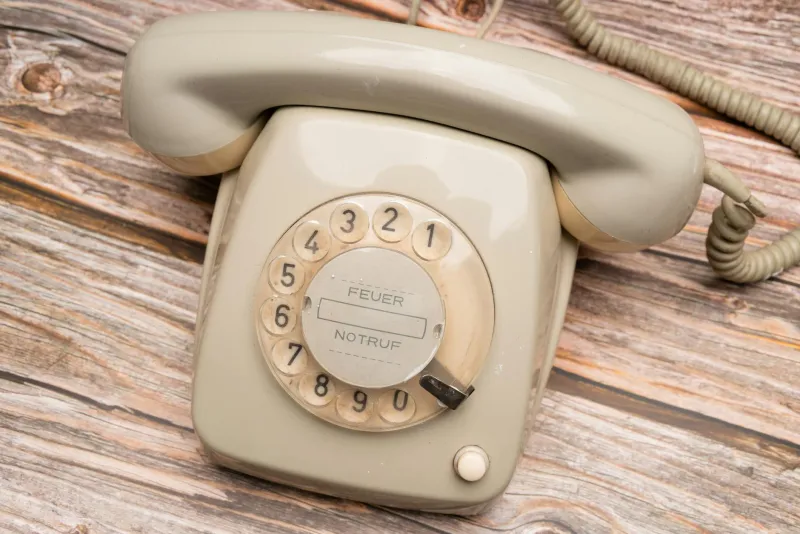
Rotary phones made this even more visceral. Dialing your girlfriend's number meant committing to each digit, waiting for the wheel to return before continuing. There was no speed-dial, no contacts list—just you, the phone, and whatever numbers you'd managed to burn into your brain through repetition.
The Paradox of Infinite Access
Today, we carry access to virtually all human knowledge in our pockets, yet we remember less than ever before. We can video call someone on the other side of the planet instantly, but we can't recall the number of the person sitting next to us.
This creates an odd dependency: we're simultaneously more connected and more helpless than any generation in human history. Lose your phone, and you've lost your ability to contact most of the people in your life. Your grandmother, stranded without her address book, could still remember half the numbers she needed.
A Different Kind of Intelligence
Perhaps this isn't entirely a loss. While we've surrendered our role as human phone books, we've freed up mental resources for other kinds of thinking. Today's young adults might not remember phone numbers, but they can navigate complex digital environments, synthesize information from multiple sources simultaneously, and adapt to new technologies with remarkable speed.
The question isn't whether this change is good or bad—it's already happened. But understanding what we've traded away helps us recognize both the power and the vulnerability of our hyper-connected world. In gaining access to everything, we've lost the ability to remember anything.
Your brain used to be a library. Now it's more like a search engine. The information is still there—it's just not stored where it used to be.