Your Backyard Fence Line Used to Be a Social Highway: The Death of American Neighborhood Life
When Your Street Was Your Social Network
In 1970, if you needed a cup of sugar, you knocked on Mrs. Peterson's door. If your car wouldn't start, Bob from three houses down had jumper cables and fifteen minutes to spare. Children played elaborate games of kick-the-can that spanned entire blocks, with parents keeping watch from front porches like benevolent sentries.
This wasn't Norman Rockwell nostalgia. This was how American neighborhoods actually functioned for most of the 20th century. Your street wasn't just where you lived—it was your primary social ecosystem, your informal safety net, and often your entertainment center rolled into one.
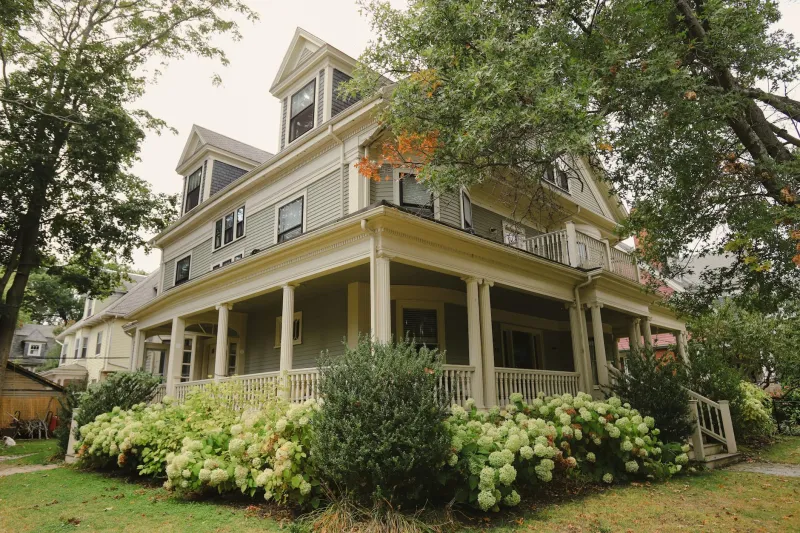
Today's reality reads like science fiction to anyone who lived through that era. Harvard's Social Capital Community Benchmark Survey found that Americans are 35% less likely to have dinner with neighbors compared to 1974. Block parties, once as common as backyard barbecues, have virtually disappeared from most suburban landscapes. The front porch—once America's social command center—has been replaced by the private deck, facing away from the street.
The Great Retreat Indoors
The transformation didn't happen overnight. It was death by a thousand conveniences, each one perfectly logical in isolation.
Air conditioning fundamentally changed American social patterns in ways we're still discovering. Before central air became standard in the 1970s, summer evenings meant open windows, front porch sitting, and natural congregation outdoors. The heat drove people together. Once families could retreat to climate-controlled comfort, the evening porch gatherings simply evaporated.
Suburban sprawl played its part too. The post-war boom scattered extended families across metro areas. Where grandparents, aunts, and cousins once lived within walking distance, families now needed cars to visit relatives. Neighborhoods became collections of nuclear family units rather than interwoven social networks.
The two-income household, while economically necessary for most families by the 1980s, meant less time for casual neighborhood interaction. When both parents work full-time, spontaneous conversations over the fence become scheduled playdates—if they happen at all.
When Everyone Became Their Own Entertainment System
Perhaps nothing changed neighborhood dynamics more than the evolution of home entertainment. In 1960, most American homes had one television with three channels. Boredom naturally drove people outdoors and toward each other.
Compare that to today's average household: multiple screens, streaming services with infinite content, gaming systems, and smartphones providing endless distraction. Why chat with your neighbor about the weather when Netflix has forty-seven shows you're "meaning to watch"?
The shift was gradual but devastating to community bonds. Children who once organized elaborate neighborhood games now schedule virtual playdates with friends they may never meet in person. Parents who once coordinated informally over backyard fences now communicate through neighborhood Facebook groups—if at all.
The Safety Paradox
Ironically, as America became statistically safer, we began acting as if danger lurked behind every front door. The 1980s and 1990s brought a media-fueled perception of stranger danger that sent children indoors and parents into protective mode.
The numbers tell a different story. Violent crime rates have dropped significantly since the 1990s, yet neighborhood trust has continued to erode. We've created the safest, most isolated communities in human history.
This manufactured fear changed everything. Children who once roamed freely within a several-block radius now require supervised playdates. Parents who once relied on informal neighborhood watching now install security cameras and track their kids' every movement via smartphone.
What We Lost When We Stopped Talking
The health implications of this social retreat are only now becoming clear. Studies link neighborhood social connections to everything from cardiovascular health to cognitive function in older adults. People with strong neighborhood ties report better mental health, faster recovery from illness, and greater life satisfaction.
But the loss goes beyond individual health. Strong neighborhoods once served as informal social safety nets. Single mothers could count on neighbors for emergency childcare. Elderly residents had multiple people checking on them regularly. Job opportunities spread through casual conversations rather than online applications.
These weren't perfect systems—they often excluded newcomers and reinforced social hierarchies. But they provided something we've struggled to replace: the security of being known, of belonging somewhere specific.
The Digital Replacement That Isn't
Neighborhood apps like Nextdoor promise to rebuild community connections through technology. Instead, they often amplify the worst aspects of neighborhood dynamics: petty complaints, racial profiling disguised as "safety concerns," and endless debates about parking regulations.
Digital communication lacks the humanizing effect of face-to-face interaction. It's easier to complain about your neighbor's barking dog in a group chat than to have a friendly conversation about it over the fence. Technology that was supposed to connect us has often made us more suspicious and less empathetic toward the people living closest to us.
The Warped Timeline of American Isolation
In just fifty years, we've fundamentally rewired how humans relate to their immediate environment. For most of human history, knowing your neighbors wasn't just common courtesy—it was survival. Today, it's become almost quaint.
We've gained privacy, convenience, and individual freedom. But we've lost something harder to quantify: the deep security that comes from being embedded in a web of local relationships. In our rush toward independence, we may have accidentally engineered the loneliest society in human history.
The irony is stark. We're more connected to distant friends than ever before, yet increasingly isolated from the people who share our zip code. We know more about celebrities' daily lives than about the family next door. In gaining the whole world through our screens, we may have lost our own neighborhoods.