America Threw Away the Greatest Show on Earth: How We Lost Our Nightly Appointment with the Universe
When Every American Was an Astronomer
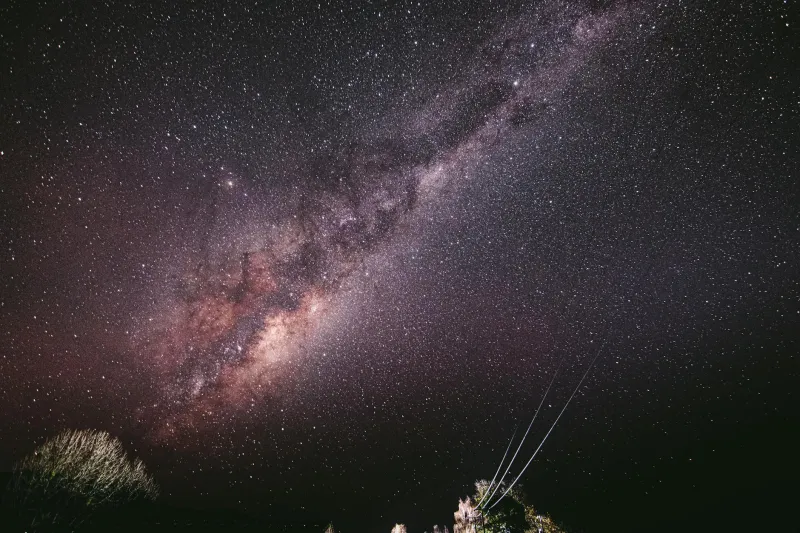
On any clear evening in 1900, a farmer finishing his chores could look up and see roughly 2,500 individual stars scattered across a canvas so rich it took your breath away. The Milky Way stretched overhead like a cosmic highway, so bright it cast shadows on moonless nights. Children learned constellations the way they learned their ABCs—Orion, Cassiopeia, and the Big Dipper were as familiar as neighborhood landmarks.
 Photo: Milky Way, via cdn.pixabay.com
This wasn't a special experience reserved for camping trips or observatory visits. This was Tuesday night in America.
Today, that same view has vanished for four out of five Americans. If you live in or near any major city, you inhabit a world where the night sky has been reduced to a dim orange glow punctuated by perhaps two dozen visible stars. The Milky Way—our own galaxy, containing 400 billion stars—has become invisible to most of the American population.
We didn't lose the stars through some cosmic catastrophe. We simply turned on too many lights and forgot to look up.
The Gradual Theft of Darkness
The transformation happened slowly enough that most people didn't notice. In 1950, small towns across America still experienced genuine darkness after sunset. Streetlights were sparse and dim. Businesses closed at reasonable hours and turned off their signs. The night belonged to stars, not sodium vapor.
Then came the great brightening. Shopping centers needed parking lot lighting. Highways required illumination for safety. Suburban developments sprouted streetlights every few hundred feet. Businesses discovered that brightly lit signs attracted customers even when they were closed.
Each individual light made perfect sense. Parking lots should be safe. Highways should be visible. But collectively, millions of perfectly reasonable lighting decisions created an unintended consequence: we accidentally turned off the stars.
The numbers tell the story. In 1950, there were roughly 200,000 streetlights in America. Today, there are over 26 million, plus countless billions of other light sources. Satellite images show the continental United States as a blazing web of illumination visible from space—beautiful and devastating in equal measure.
What a Real Night Sky Actually Looked Like
For anyone under fifty who's lived in or near cities their entire lives, descriptions of a truly dark sky sound like fantasy. But this was reality for most of human history.
Under genuinely dark skies, the Milky Way doesn't appear as a faint smudge—it dominates the entire sky like a river of light. You can see your shadow cast by starlight alone. The zodiacal light—sunlight reflected off interplanetary dust—creates a pyramid of illumination after sunset. Galaxies like Andromeda appear as distinct cloudy patches rather than invisible points requiring telescopes.
More remarkably, your eyes adapt to this darkness in ways modern Americans never experience. After thirty minutes without artificial light, human vision becomes sensitive enough to navigate by starlight. Colors become visible in nebulae. The three-dimensional depth of space becomes apparent as closer and more distant stars separate into distinct layers.
This wasn't just visual entertainment. For thousands of years, the night sky was humanity's calendar, compass, and clock. Farmers planted by moon phases visible in detail. Travelers navigated by constellations that stood out clearly. Entire cultures organized their mythologies around star patterns everyone could see.
The Cultural Astronomy We Lost
American indigenous tribes had sophisticated astronomical knowledge based on naked-eye observation. The Lakota used star positions to determine buffalo hunting seasons. Pueblo peoples aligned their ceremonies with celestial events visible to everyone. This wasn't primitive science—it was practical astronomy based on a sky that actually worked as a reliable reference.
Early European settlers continued these traditions. Farmers' almanacs provided planting guidance based on moon phases and star positions. Sailors learned celestial navigation as a basic survival skill. Children grew up with an intuitive understanding of how the Earth moved through space because they could watch it happen every night.
This cultural connection to astronomy didn't require education or equipment—it was free entertainment and practical knowledge available to anyone willing to step outside and look up. The night sky was democracy in action: the same cosmic show played equally for rich and poor, educated and illiterate, urban and rural.
When we lost the stars, we lost this shared cultural reference point. Astronomy became something that happened in planetariums rather than backyards, something that required telescopes rather than curiosity.
The Psychology of Cosmic Perspective
There's growing evidence that regular exposure to star-filled skies affects human psychology in ways we're only beginning to understand. Psychologists call it "awe"—the emotion triggered by experiencing something vast and beautiful that puts your daily concerns into perspective.
For most of human history, this cosmic perspective was available every clear night. Standing under a sky filled with hundreds of billions of visible stars naturally triggered thoughts about humanity's place in the universe, the passage of time, and the relative importance of immediate worries.
Modern Americans rarely experience this kind of awe unless they specifically seek it out. We've inadvertently eliminated one of humanity's most reliable sources of perspective and wonder. Instead of ending each day with a reminder of cosmic vastness, we end it scrolling through social media feeds filled with artificially amplified human drama.
The mental health implications may be significant. Studies suggest that regular experiences of awe correlate with reduced anxiety, increased life satisfaction, and greater sense of connection to something larger than individual concerns. We may have accidentally eliminated a form of natural therapy that human brains evolved to expect.
The Unintended Consequences of Safety Lighting
The irony is that much of our light pollution stems from good intentions. We wanted safer streets, more secure parking lots, and better visibility for drivers. But research suggests that more lighting doesn't always equal more safety.
Poorly designed lighting can actually reduce visibility by creating harsh shadows and glare. Many parking lots are over-lit to the point where they cause temporary blindness when you enter or leave. Some studies suggest that excessive lighting may increase certain types of crime by providing better visibility for criminal activity.
Meanwhile, the ecological costs of light pollution are becoming clear. Migrating birds—many species navigate by stars—become confused by artificial lighting, leading to millions of deaths annually. Sea turtle hatchlings, programmed to follow moonlight to the ocean, instead follow street lights toward parking lots. Nocturnal pollinators lose their navigation systems.
We solved problems that may not have existed while creating problems we didn't anticipate.
What Dark Sky Communities Are Learning
A small but growing movement of "dark sky communities" is proving that we can have safety and stars simultaneously. Places like Flagstaff, Arizona, and parts of Utah have implemented lighting ordinances that provide necessary illumination while preserving night sky visibility.
 Photo: Flagstaff, Arizona, via www.flagstaffarizona.org
The solutions are surprisingly simple: shield lights so they point down rather than up and out, use warmer color temperatures that cause less sky glow, and turn off unnecessary lighting during late night hours. These communities report no increase in crime or accidents, but dramatic improvements in sky visibility.
Visitors to these areas often experience something approaching culture shock. Adults who grew up in cities describe seeing the Milky Way for the first time as a life-changing experience. Children ask if the stars are real or if someone is projecting them.
The Warped Timeline of American Nights
In just one century, we've transformed the American night from a window into the universe into a ceiling of artificial glow. We've gained security and lost wonder. We've illuminated our immediate surroundings while making ourselves blind to our cosmic surroundings.
The change happened gradually enough that most people didn't notice what we were losing. But satellite comparisons show the dramatic scope: areas that were dark enough to see thousands of stars in 1950 now reveal fewer than fifty.
We've become the first generation in human history to grow up largely disconnected from the night sky that guided, inspired, and humbled our ancestors for millennia. In gaining control over darkness, we may have lost something essential about what it means to be human under the stars.
The cosmos is still there, of course. Every star that guided ancient navigators still shines overhead. We've simply made ourselves unable to see our place in the universe. In our rush to light up the night, we forgot that some things are more beautiful in the dark.