The Human Hard Drive: How Americans Once Stored Their Entire Lives in Their Heads
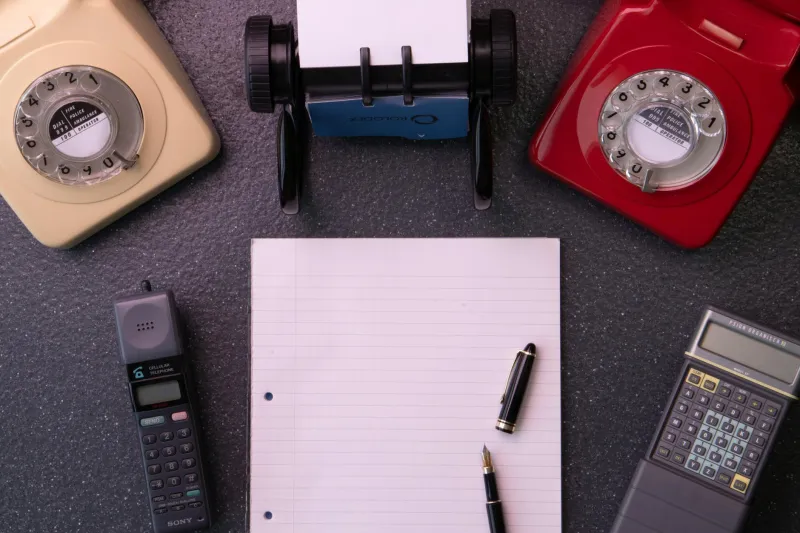
The Phone Number Olympics
Every American used to be a memory athlete without realizing it. Your brain contained a personal phone directory that would make today's contact apps jealous. You knew your parents' work numbers, your best friend's home line, the pizza place that delivered until midnight, your doctor's office, and at least a dozen other digits that connected you to the people and services that mattered.
These weren't just random numbers—they were lifelines encoded in neural pathways through sheer repetition. You dialed your girlfriend's number so many times that your fingers could punch it in while your mind wandered elsewhere. The rhythm of those seven digits became as familiar as your own name: 555-3847 had its own musical cadence that you'd never forget.
Losing access to a phone number was genuinely traumatic because it meant losing access to a person. If you moved and forgot to write down your neighbor's number, that relationship might simply evaporate. There was no digital safety net, no "recently called" list to consult. Your memory was the only backup system that existed.
The Mental Atlas of America
Before GPS, Americans navigated using an internal mapping system that would impress today's AI developers. You didn't just know how to get places—you knew multiple routes, understood traffic patterns, and could provide detailed directions to anyone who asked.
People carried comprehensive mental maps of their cities, complete with landmarks, shortcuts, and alternative routes for different times of day. "Take Main Street to the old Sears, turn left at the gas station with the big sign, go about two miles until you see the white church, then turn right" was the standard format for human navigation systems.
This spatial knowledge extended beyond driving directions. You knew bus schedules, train timetables, and the walking distances between important locations. Your brain stored a three-dimensional model of your environment that updated constantly as you moved through the world. Getting lost wasn't just inconvenient—it was genuinely disorienting because it meant your internal compass had failed.
The Accountant in Your Head
Every American used to be their own personal financial tracking system. You knew your checking account balance not because you checked an app, but because you maintained a running mental ledger of every deposit and withdrawal. Balancing a checkbook wasn't just a monthly chore—it was a way of confirming that your internal accounting matched reality.
This mental bookkeeping extended to all areas of personal finance. You knew exactly how much cash was in your wallet without counting it. You could estimate your monthly expenses from memory. You tracked your credit card spending in your head because the alternative was unpleasant surprises when the bill arrived.
People developed sophisticated mental systems for managing money that required no external tools. They knew which bills were due when, how much each one typically cost, and whether they had sufficient funds to cover unexpected expenses. This internal financial awareness created a different relationship with money—more intimate, more immediate, and more personal.
The Calendar Between Your Ears
Scheduling used to happen entirely inside people's heads. You remembered doctor's appointments, work meetings, social gatherings, and family obligations without writing anything down. Your brain was a sophisticated scheduling system that tracked not just your own commitments, but often those of your family members as well.
Mothers were particularly impressive human databases, storing the schedules of multiple children, their own work obligations, household maintenance tasks, and social commitments in a complex mental matrix. "Tommy has soccer practice at 4, Sarah's piano lesson is at 5:30, dinner with the Johnsons is Saturday at 7" wasn't written anywhere—it was just known.
This mental scheduling created natural limits on how much people could realistically commit to. If you couldn't remember an obligation, you probably shouldn't take it on. The capacity of human memory served as a built-in protection against over-scheduling that our digital calendars have completely eliminated.
The Social Security of Shared Knowledge
One of the most remarkable aspects of pre-digital memory was how it was distributed across social networks. If you forgot someone's phone number, you could call a mutual friend who probably remembered it. If you couldn't recall the name of that restaurant downtown, your coworker likely could. Community memory was a collective resource that everyone contributed to and drew from.
This created a different kind of social interdependence. People needed each other not just for emotional support, but for practical information management. Forgetting something wasn't just a personal problem—it was a reason to reach out and connect with others who might fill in the gaps.
Families developed specialized memory roles. Dad remembered directions and phone numbers. Mom remembered birthdays and appointments. Kids remembered television schedules and their friends' addresses. Each person served as a backup system for the others, creating redundancy that protected against information loss.
The Muscle Memory of Daily Life
Beyond specific facts and figures, Americans developed sophisticated procedural memories for navigating daily life. You knew the exact sequence of buttons to press on your VCR to record a show. You could operate your car radio without looking at it. You knew which grocery store aisles contained which products and could shop efficiently without consulting any lists.
This muscle memory extended to work environments, where people developed intricate mental models of their professional systems. Secretaries knew the extension numbers for everyone in the company. Mechanics could diagnose car problems by sound alone. Waitresses remembered complex orders for entire tables without writing anything down.
These skills weren't just impressive—they were essential for professional competence. Your value as an employee was partly measured by how much institutional knowledge you carried in your head and how quickly you could access it when needed.
The Great Cognitive Outsourcing
The transition from mental storage to digital assistance happened gradually, then suddenly. First came personal computers that could store phone numbers and addresses. Then came smartphones that eliminated the need to remember anything at all. Now we live in a world where most people can't recall their own mother's phone number because it's stored in their contacts under "Mom."
This cognitive outsourcing has been remarkably thorough. We've delegated not just factual recall to our devices, but also spatial navigation, temporal awareness, and even basic arithmetic. The average smartphone user has access to more information than the greatest scholars of previous generations, but can't function without their device for more than a few hours.
What We Lost in the Upload
The shift from human to digital memory represents more than just convenience—it's a fundamental change in how we relate to information and, by extension, to our own lives. When you had to remember someone's phone number to call them, that number became part of your relationship with that person. When you had to memorize directions to visit someone, those routes became part of your connection to that place.
Modern digital assistance has made us more capable but less connected to the practical details of our own existence. We can access any fact instantly, but we no longer carry our lives with us in the same intimate way. The information is available, but it's not ours—it belongs to the cloud, the app, the device that we hope will never fail us.
Perhaps most importantly, we've lost the confidence that comes from truly knowing things. When your memory was your only option, you developed trust in your own mind. Now, surrounded by digital assistants, we've become hesitant to rely on our own recall, even when we're certain we remember something correctly. We've gained access to unlimited information while losing faith in our own ability to know anything at all.