Coast to Coast Used to Mean Something: The Lost World of Pre-Highway America
Coast to Coast Used to Mean Something: The Lost World of Pre-Highway America
Pull up Google Maps and ask it how long it takes to drive from New York City to Los Angeles. It'll tell you about 40 hours of driving — four or five days if you're taking it easy, stopping at motels, eating at diners along the way. Annoying, maybe. Long, definitely. But completely doable for anyone with a week and a tank of gas.
Now imagine that same trip in 1920. Or even 1950. The car exists. The destination exists. Everything in between? That's where it gets complicated.
The Road Before the Roads
In the early decades of automobile travel, driving across the United States wasn't a vacation. It was closer to an act of optimism bordering on recklessness.
The Lincoln Highway — established in 1913 as the first coast-to-coast automobile route — sounds impressive until you learn what it actually was: a loosely connected patchwork of local roads, many of them unpaved dirt tracks that turned to mud in the rain and dust in the dry heat. There were no standardized signs. No guaranteed fuel stations. No consistent lodging. Travelers packed supplies like they were heading into the wilderness, because in many stretches, they effectively were.
A cross-country drive in the 1920s typically took three to four weeks — and that assumed no major mechanical failures, no washed-out roads, and no getting genuinely lost in stretches of Wyoming or Nevada where the next town was 60 miles away on a road that barely deserved the name.
Emily Post — yes, the etiquette author — made the drive in 1915 and later wrote about it in a book called By Motor to the Golden Gate. Her account describes axle-deep mud, wrong turns that added days to the journey, and the very real possibility of being stranded far from any help. This was not an unusual experience. It was just the reality of the road.
Eisenhower's Obsession and the System That Changed Everything
The man most responsible for modern American road travel first understood the problem in 1919, when a young Army officer named Dwight D. Eisenhower participated in the first U.S. Army transcontinental motor convoy. The convoy left Washington D.C. on July 7th and arrived in San Francisco on September 6th — 62 days later. The journey covered roughly 3,200 miles and averaged about 58 miles per day. Vehicles broke down constantly. Roads collapsed under the weight of military trucks. Bridges had to be rebuilt along the way.
Eisenhower never forgot it. When he became president in 1953, he pushed for what would become the Federal Aid Highway Act of 1956 — the legislation that authorized the Interstate Highway System. His other influence was more sobering: as Supreme Allied Commander in World War II, he'd seen Germany's Autobahn and understood what a modern highway network meant for moving people, goods, and, if necessary, military equipment at scale.
Construction began almost immediately and continued for decades. By the time the system reached something close to completion in the 1990s, it comprised over 46,000 miles of controlled-access highway connecting virtually every major city in the country.
What the Drive Became
The transformation wasn't just about speed, though the speed change was staggering. Where the 1919 Army convoy averaged less than 60 miles a day, a modern driver on Interstate 80 can comfortably cover 600 miles in a single day of driving. The same route that once took two months now takes less than a week — and that's if you're stopping to actually see things.
More than the time, though, what changed was the certainty. Pre-interstate travel was defined by uncertainty: Would the road hold? Would there be fuel? Would the bridge take the weight? Modern highway travel eliminated most of that anxiety. The infrastructure became predictable in a way that genuinely transformed who could travel and how often.
The family road trip — a fixture of American cultural identity from the 1950s onward — was essentially a product of the highway system. Before it, long-distance driving was for the adventurous or the desperate. After it, loading the station wagon and heading to Yellowstone or the Grand Canyon became something ordinary families actually did.
The Towns the Highways Left Behind
But the interstate story has a shadow side that doesn't always make it into the nostalgia.
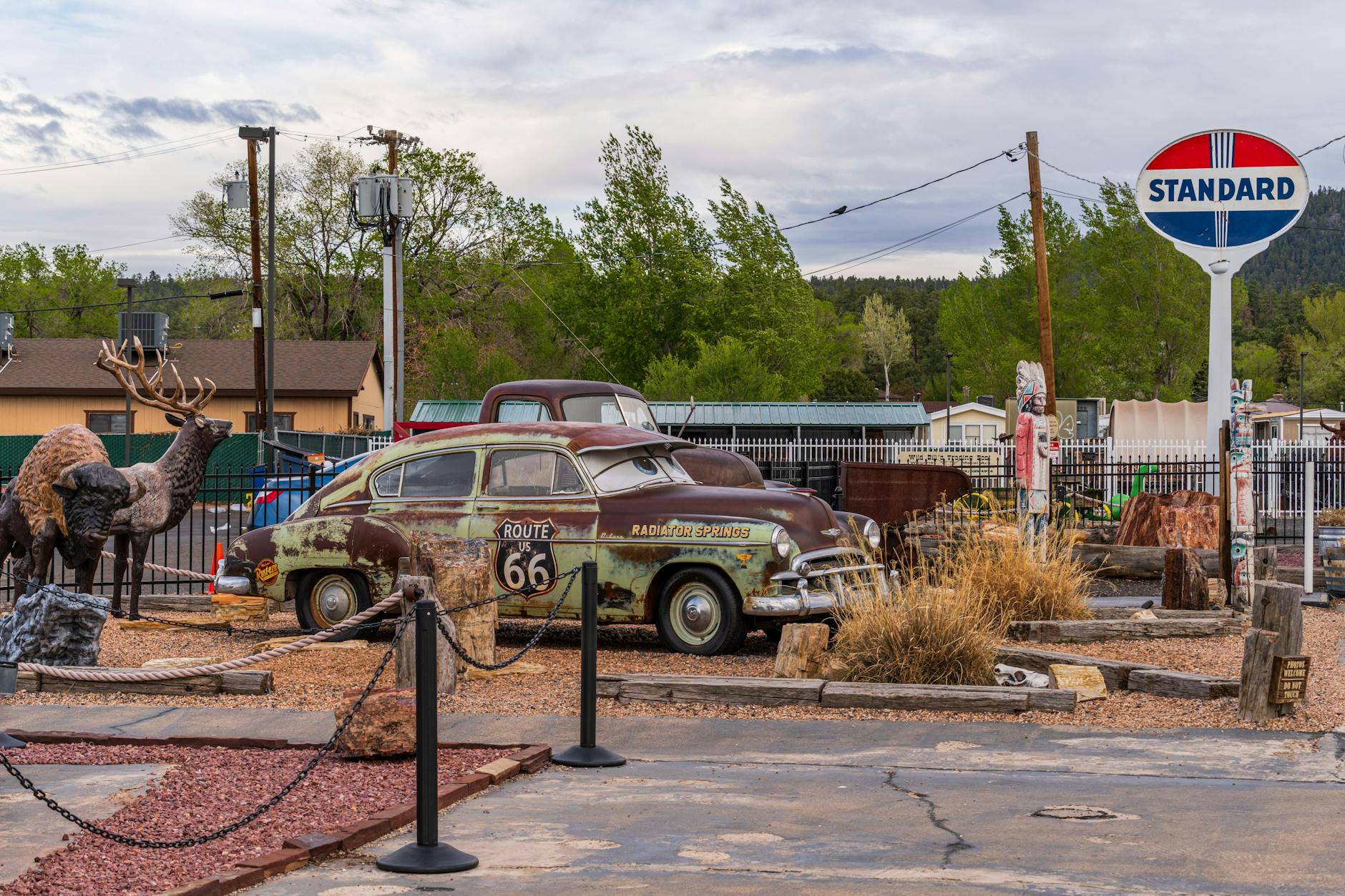
Route 66 — the old "Main Street of America" running from Chicago to Santa Monica — was once the lifeblood of dozens of small towns across Missouri, Oklahoma, Texas, New Mexico, and Arizona. Travelers had no choice but to pass through them, stop for gas, eat at local diners, sleep at motor courts. Those towns existed in a real economic relationship with the road.
When Interstate 40 bypassed large sections of Route 66 through the 1970s and '80s, many of those towns didn't just lose traffic — they lost their reason to exist. Diners closed. Gas stations shuttered. Populations drained away. Ghost towns that today attract curious travelers as ruins were once living communities whose entire economy ran on the slow, winding road that used to go through the middle of them.
The interstate made America faster and more connected in some ways, and smaller and more homogenized in others. The regional character that came from travelers having to stop, eat local food, sleep in locally owned motels, and talk to people who lived there — that largely disappeared behind the off-ramp sameness of chain restaurants and franchise hotels.
The Open Road, Redefined
There's still something genuinely compelling about driving across America. The scale of the country, the shift in landscape from the Appalachians to the plains to the Rockies to the desert — no flight captures that the way a drive does.
But the experience is fundamentally different from what it once was. The unpredictability is gone. The local texture is largely gone. What remains is speed, convenience, and a kind of controlled freedom — which is still something, just not quite the same thing that Emily Post was writing about when she dug her car out of the mud somewhere in Nebraska in 1915.
The highway system gave Americans the ability to move. What it cost, quietly, was the experience of actually arriving.