The Two-Hour Stare: What Americans Did Before Phones Filled Every Empty Moment
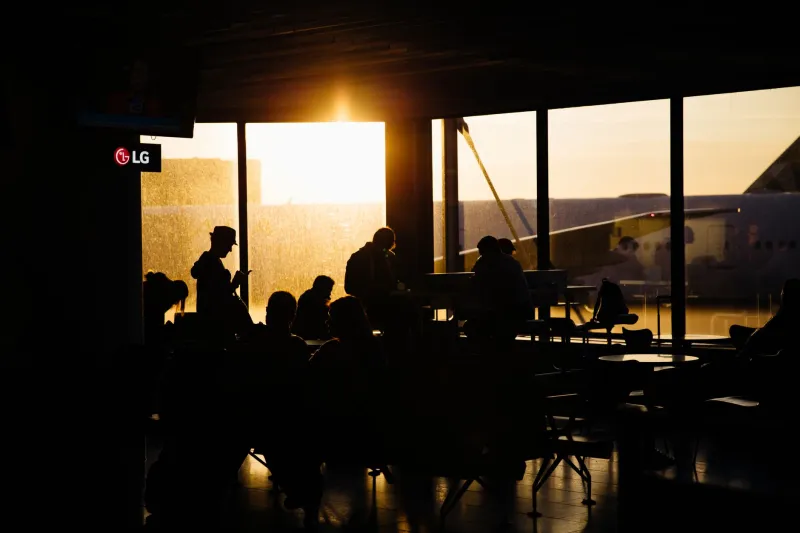
Picture a domestic airport gate in 1987. The plane is delayed. Nobody knows by how much. There are no departure boards with live updates, no apps sending push notifications, no podcasts queued up and ready to go. There are maybe forty people sitting in molded plastic chairs, and every single one of them is just... there. Existing. Waiting.
What did they do? More than you might think — and more than most of us do now.
The Waiting Room as a Way of Life
For most of the 20th century, waiting was not an inconvenience Americans could engineer away. It was woven into daily life as reliably as breakfast. You waited at the DMV, the doctor's office, the bus stop, the barbershop, the pharmacy counter. You waited for your name to be called, for the bus to arrive, for the train to pull in. There were no alternatives. The wait was simply the wait.
And so Americans adapted. They developed a whole quiet ecosystem of behaviors that filled those gaps — behaviors that, viewed from today, look almost meditative.
The dog-eared magazine was the most visible artifact of this era. Waiting rooms across the country maintained stacks of them: issues of Reader's Digest, People, Sports Illustrated, Good Housekeeping — often months out of date, their covers soft from handling. Nobody minded. Reading a three-month-old profile of a baseball player you barely cared about was still better than staring at the wall, and it passed the time in a way that felt almost productive. You learned something small. You turned pages. Your hands were occupied.
 Photo: Good Housekeeping, via magazine.imgix.net
 Photo: Sports Illustrated, via media-cldnry.s-nbcnews.com
 Photo: Reader's Digest, via imageworx-cdn.magazine-services.net
Beyond magazines, there was people-watching — which sounds passive but was actually a surprisingly active mental exercise. You noticed the woman across the room who kept checking the clock. You constructed a story about the man in the suit who looked like he hadn't slept. You eavesdropped, almost involuntarily, on the couple two seats over debating whether to get a dog. None of it was directed entertainment. All of it required your brain to do the work.
The Strange Gift of Having Nothing to Do
Here's the thing that gets lost in nostalgia: waiting used to be genuinely uncomfortable. It wasn't peaceful. It was boring in a way that made your skin itch a little. The clock moved slowly. Your mind drifted in directions you hadn't planned.
But that drift — that unplanned mental wandering — turns out to have been doing something important.
Neuroscientists now have a name for what the brain does when it's not focused on a task: the default mode network. It's the mental state associated with daydreaming, self-reflection, memory consolidation, and creative problem-solving. When you're staring out a rain-streaked bus window with nothing to read and nowhere to be, your brain doesn't go idle. It goes inward. It processes. It connects things.
For most of human history, people got enormous amounts of this unstructured mental time without trying. Waiting rooms delivered it by force. Long commutes delivered it. Boring Sunday afternoons delivered it. The mind had no choice but to wander, and wandering, it turned out, was useful.
The Conversations That No Longer Happen
One underappreciated casualty of the smartphone era is the stranger conversation. Not the deep kind — just the small, human kind that used to happen naturally in waiting spaces.
You'd make eye contact with someone. One of you would nod at the clock. The other would say something dry about the wait. A brief exchange would follow — about the weather, about wherever you were both headed, about nothing in particular. It lasted three minutes and meant nothing. Except that it was a small reminder that the world was full of people, and that most of them were reasonable, and that talking to a stranger was not inherently threatening.
Those micro-conversations happened constantly in pre-smartphone America, because waiting rooms gave people no other option. The alternative to talking was sitting in silence next to someone, which felt stranger than just saying something. Phones removed that social pressure entirely. Now everyone has an excuse to look away, and most people take it.
When Boredom Was the Point
There's a reasonable argument that the complete elimination of idle time has costs that don't show up on any balance sheet. Rates of anxiety have climbed sharply in the same decades that smartphones became universal. Attention spans have measurably shortened. The ability to sit comfortably with silence — once a basic adult skill — now requires active practice for many people.
None of this is a straightforward case against technology. Smartphones are genuinely useful. Filling a wait with something interesting is not inherently harmful. The problem is more subtle: when every moment becomes fillable on demand, the capacity to tolerate unfilled moments begins to erode. And some of those unfilled moments were doing quiet work that we didn't fully appreciate until they were gone.
The waiting rooms are still there. The plastic chairs haven't changed. But the people in them are somewhere else entirely now — scrolling, streaming, texting — and the two-hour stare has become almost extinct.
What the brain used to do with that time, it largely doesn't do anymore. Whether that matters is a question worth sitting with — ideally, without looking at your phone.