The Man Who Knew You Were Out of Milk Before You Did: America's Forgotten Doorstep Economy
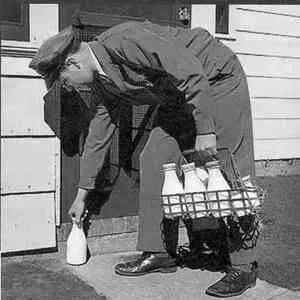
Photo: 1950s milkman delivering milk bottles front porch suburban neighborhood, via i.pinimg.com
The Man Who Knew You Were Out of Milk Before You Did: America's Forgotten Doorstep Economy
Somewhere around 4 in the morning, while your great-grandmother was still asleep, a man in a white uniform was quietly placing glass bottles on her front step. He knew exactly how many she needed. He knew which days she wanted cream. He knew, without being told, that the family had guests last weekend because the usual order wasn't enough and she'd left a note in the empty bottle.
He knew all of this because he'd been doing it for years. And he'd be back on Thursday.
A Household That Ran Itself
For the first half of the twentieth century, the American home was serviced by an invisible network of workers operating on clockwork schedules that most families barely had to think about. The milkman was just the most recognizable figure in a much larger ecosystem.
The iceman came before refrigeration became standard, hauling heavy blocks into kitchen iceboxes that kept food from spoiling. The coal deliverer filled basement bins through a chute in the side of the house — often without anyone needing to be home. Bread routes wound through residential streets several times a week, dropping off fresh loaves at doorsteps. Some neighborhoods had egg men, fruit routes, even fish deliveries on Fridays for Catholic households.
This wasn't convenience in the modern sense. It was infrastructure. A quietly humming system that kept households fed and functional, built on local knowledge, personal relationships, and an extraordinary degree of mutual trust.
The Economics of the Route
What made the doorstep delivery economy work wasn't technology — it was geography and repetition. These routes were hyperlocal. A milkman might cover thirty or forty homes within a few square miles, six days a week, for years at a stretch. He didn't just know your address. He knew your family.
Payment was often handled informally. Some customers left cash in the empty bottles. Others settled up weekly. A surprising number ran tabs that were squared at the end of the month, based entirely on trust and the understanding that everyone knew where everyone else lived.
The economics were tight but stable. Dairy companies, bakeries, and ice suppliers built their entire distribution models around these routes. Drivers were often independent contractors who essentially owned their customer lists — a genuinely valuable asset in an era when personal relationships were the only form of customer data that existed.
What the Refrigerator Killed
The collapse of the doorstep delivery system didn't happen overnight, but the refrigerator accelerated it dramatically. Once households could reliably store milk for a week rather than two days, the daily delivery lost its urgency. Supermarkets, expanding rapidly through the 1950s and 60s, offered lower prices and the novelty of choice. Families bought cars. Suburbs sprawled outward. The tight geographic logic that made the routes viable began to break down.
By the 1970s, home milk delivery had dropped from covering the majority of American households to a small fraction. The iceman had already been gone for a generation. Bread routes shrank to specialty items. The whole ecosystem quietly folded into the supermarket economy, and most people were too busy enjoying the convenience of the grocery store to notice what had disappeared from their front steps.
The Trust That Ran the System
What's genuinely striking about the old doorstep economy, viewed from today, isn't the logistics — it's the social fabric underneath them. These arrangements operated on a level of community trust that's almost difficult to imagine now.
A milkman had access to your home's exterior and, often, your unlocked porch or mudroom at 4 a.m. He knew whether you were home, whether your routine had changed, whether something seemed off. In many documented cases, delivery workers actually raised alarms when elderly customers hadn't taken in their bottles — a quiet, informal welfare check built into the commercial routine.
None of this was contractual. None of it was tracked. It existed because people knew each other, or at least knew each other's patterns well enough to notice when something was wrong.
From the Milk Bottle to the Smart Doorbell
Modern delivery culture has, in some ways, come full circle. Amazon Prime, grocery delivery apps, subscription meal kits — Americans are once again having goods brought directly to their doors at regular intervals. In 2024, the US home delivery market was worth hundreds of billions of dollars.
But the comparison only goes so far. Today's delivery ecosystem is almost entirely anonymous. The driver who drops your groceries hasn't been coming to your house for eight years. They don't know you prefer whole milk or that you always order extra when the kids are home from college. They're navigating your street for the first time using a GPS app, and they'll likely never come back.
The old doorstep economy was intimate in a way that modern logistics simply isn't designed to be. It wasn't just about getting things to people — it was about people knowing people. And that distinction, quiet as it seems, made the neighborhood feel like something more than a collection of addresses.
The milk still arrives. But nobody knows your name anymore.