Red Lights and Rubber Gloves: When Taking a Good Photo Required a Lab in Your Basement
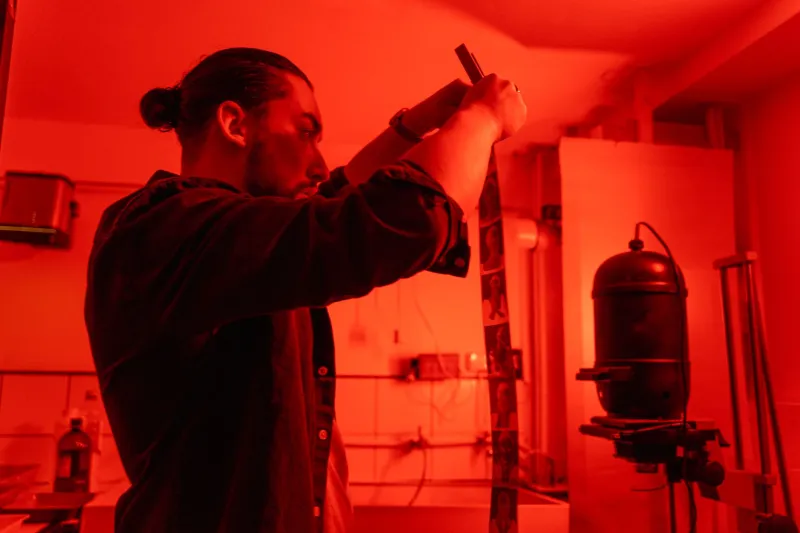
Somewhere in suburban America, in the 1970s and 1980s, there was a dad with a converted bathroom. The window was covered in black plastic sheeting. A red safelight hung from the ceiling. Trays of chemicals lined the counter — developer, stop bath, fixer — each one smelling faintly of something between a swimming pool and a high school science lab. He wore rubber gloves and worked in near-total darkness, watching a blank sheet of paper slowly reveal an image, like a magic trick that took twenty minutes and required a chemistry degree to pull off.
This was photography. The real kind. The kind that demanded something from you.
The Camera Was Just the Beginning
Most people who shot film in the mid-twentieth century didn't develop their own photos. They dropped the roll at the drugstore or the camera shop, paid a few dollars, and picked up an envelope of prints a week later. That was the consumer version of photography — accessible, but completely out of your hands once the shutter clicked.
But for serious photographers — the ones who wanted control over how their images actually looked — there was no shortcut. You had to build or rent a darkroom. You had to buy an enlarger, a timer, trays, tongs, chemicals, and the right paper. You had to learn how long to expose a print, how to dodge and burn specific areas to control brightness, how to agitate the developer tray at just the right rhythm to get even development across the entire image.
And all of this was before you even got to the question of whether the original photograph was any good.
The investment — in money, time, and knowledge — was substantial. A decent enlarger alone could cost several hundred dollars in 1975, which is well over a thousand in today's money. Chemicals had to be mixed, stored safely, and disposed of responsibly. The process was slow, iterative, and unforgiving. A mistake in the darkroom could ruin an entire session of carefully shot film.
Every Frame Was a Decision
Here's what that kind of friction does to a person: it makes them think before they shoot.
A standard roll of 35mm film gave you 24 or 36 exposures. That was it. Each frame cost money — not just the film, but the development chemicals, the paper for printing, and the time spent in the darkroom. Shooting casually, the way people fire off a hundred smartphone photos at a birthday party today, simply wasn't part of the culture. You composed your shot. You checked your light. You considered whether this moment was worth one of your 36 frames.
This wasn't just frugality. It was a fundamentally different relationship with the act of documentation. Photographs were rare not because cameras were rare, but because the entire pipeline — from capture to finished print — demanded enough from the photographer that every image carried weight.
Family albums from that era are thin by modern standards. A summer vacation might yield forty or fifty prints. A child's first year of life, documented across several rolls, might fill one album. Today, those same milestones generate thousands of images, most of which live on a phone and are never printed, never organized, and rarely looked at again.
The Gatekeeping Was Real — and It Mattered
Because photography required so much technical knowledge and financial commitment, the barrier to calling yourself a photographer was genuinely high. You had to earn the title through demonstrable skill. You had to understand light, exposure, and composition not as abstract concepts but as technical variables you controlled by hand.
This created a real division between photographers and everyone else. Most Americans owned a camera. Very few understood what the camera was actually doing. And almost none of them had any control over how their images were ultimately rendered — that was left to the lab technician at the drugstore, working with automated equipment and a one-size-fits-all development process.
The home darkroom changed that. It gave serious photographers the ability to interpret their negatives rather than just process them. A skilled printer could take a technically imperfect negative and produce a stunning print through careful exposure control and chemical manipulation. The darkroom was where photography became art rather than documentation.
That distinction — between snapping a picture and making a photograph — was something people actually debated and took seriously.
The Moment Digital Blew the Door Off Its Hinges
The arrival of affordable digital cameras in the late 1990s and early 2000s didn't just make photography easier. It dismantled the entire conceptual framework that had defined the medium for over a century.
Suddenly, there was no cost per frame. No chemicals. No waiting. You could see the image immediately after taking it, delete it if you didn't like it, and try again. The feedback loop that had previously taken days or weeks — shoot, develop, evaluate, adjust — collapsed into seconds.
For casual users, this was an unambiguous improvement. For serious photographers, it was more complicated. The discipline that film imposed — the deliberateness, the patience, the investment in each frame — evaporated overnight. Photography became something anyone could do, which meant it also became something harder to distinguish yourself within.
The darkroom, meanwhile, went from a creative sanctuary to a historical curiosity in roughly a decade.
What the Red Light Left Behind
There's a small but committed community of film photographers still working today, many of them young people who never shot on film as children but are drawn to it precisely because it asks something of them. They mix chemicals, load film in the dark, and spend hours in the red safelight glow producing prints by hand.
They're not doing it because it's efficient. They're doing it because the difficulty is the point.
The old darkroom taught a generation that the best things require effort, patience, and the willingness to ruin a few prints before you get it right. That lesson didn't disappear when the chemicals dried up. It just got a lot harder to stumble into accidentally.