Two Hours Each Way: The Grind That Decided Where Americans Were Allowed to Live
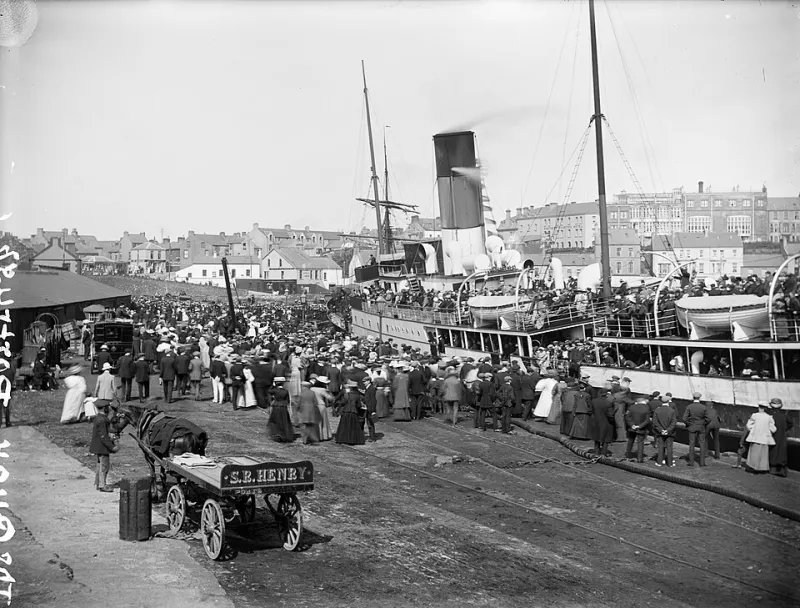
Photo: National Library of Ireland on The Commons, No restrictions, via Wikimedia Commons
Picture a machinist in Chicago in 1900. His shift starts at 7 a.m. To be there on time, he's out of bed before 5, walking to the streetcar stop in the dark, transferring once, maybe twice, and then hoofing it the last twenty minutes because the tracks simply end. When the whistle blows at 6 p.m., he does the whole thing in reverse. Four hours of his life, every day, spent just getting there and back.
That wasn't bad luck. That was the shape of the world.
The City Had a Hard Edge
Before the interstate highway system, distance wasn't measured in miles — it was measured in minutes of transit, and the minutes added up fast. If you worked in a factory, you needed to live within reach of a trolley line, a steam ferry landing, or your own two feet. Miss the last car of the evening and you were walking home by lantern light or paying for a room downtown.
The result was a country where the working class lived packed into dense neighborhoods hugging the industrial core. Housing near the streetcar lines cost more. Housing near the factories was cheap but choked with soot and noise. There was no in-between, because there was no way to bridge the gap. Your commute wasn't a preference. It was a cage, and the bars were made of rail schedules.
Wealthy Americans escaped first, via commuter railroads that stitched distant villages like Bronxville or Evanston into the workday economy. But for everyone else, the options were brutally simple: live close and cramped, or don't live there at all.
The Ferry, the Trolley, and the Hitching Post
It's easy to forget how fragile these journeys were. Steam ferries crossing to Manhattan or between Bay Area towns ran on fixed schedules and froze in winter fog. Trolleys were packed shoulder-to-shoulder during rush hours, and a single stalled car could strand hundreds. Workers who owned horses boarded them at commercial livery stables near the depot — hitching posts and feed bills were a genuine line item in a family budget, the way a car payment is today.
And the pace? A typical horse-drawn streetcar managed maybe 6 miles per hour in traffic. Even the electrified trolleys that replaced them averaged under 12 once stops and congestion were factored in. Compare that to the modern average American commute of roughly 27 minutes each way by car, and the math becomes staggering: the 1900 worker spent nearly a full waking day — every week — in transit.
The Road That Redrew the Map
Then came the Federal-Aid Highway Act of 1956, and with it, 41,000 miles of interstate. Suddenly the trip that took two hours by trolley took twenty-five minutes by Plymouth. The hard edge around the city dissolved.
Developers followed the asphalt. Levittown and its imitators sprouted on former cornfields, and the middle class did something unprecedented in human history: they moved en masse to places their grandparents couldn't have reached in a day, commuting daily to jobs miles away. The suburb wasn't an architectural invention. It was a speed invention.
Every ripple followed. Shopping moved off Main Street onto highway-frontage lots. Schools were built on the assumption of bus routes and carpools. The diner, the drive-in, the motel — entire business models only make sense once ordinary people own fast, personal machines.
What We Gained, and What We Traded
Today the average American commute is shorter in raw time than a 1900 trolley slog, and it happens in climate-controlled privacy with a podcast on. That's genuine, measurable progress — a quiet gift of a century of infrastructure that most of us never think about.
But the old constraint shaped community in ways we might miss. When everyone in the neighborhood worked within walking distance, the neighborhood knew your schedule, your employer, your kids. The commute didn't just limit where you lived; it concentrated who you lived next to.
Now the average driver covers more than 40 miles a day, and some trade the two-hour trolley ordeal for a two-hour traffic crawl — different scenery, same arithmetic. The frontier of distance keeps expanding, but the hours in a day haven't moved an inch since 1900. Some constraints, it turns out, travel with us.