Photo: toolstop, CC BY 2.0, via Wikimedia Commons
When Your Phone Call Was the Whole Neighborhood's Business
Imagine picking up your phone to make a call and hearing your neighbor already mid-conversation with someone across town. You could wait, hang up quietly, or — if you were feeling bold — just listen. Nobody would necessarily know. The technology made eavesdropping almost effortless, and in many communities across rural America, it was practically a local institution.
 Photo: rural America, via static.vecteezy.com
This wasn't a glitch or a security flaw. It was the system working exactly as designed. For much of the 20th century, party lines were how telephone service reached communities that couldn't justify the cost of individual lines. And the social world they created was unlike anything that came before or after.
One Wire, Many Lives
The telephone arrived in American life at the end of the 19th century, but for decades it remained a luxury concentrated in cities. Running individual lines to every farmhouse across rural America was expensive — the infrastructure cost simply didn't make sense for sparse populations spread across miles of countryside.
The solution was the party line: a single telephone circuit shared among multiple households, sometimes as few as two, sometimes as many as twelve or fifteen. Each household on the line had a distinct ring pattern — two short rings and a long, say, or three short bursts — so you knew which calls were meant for you. The problem, of course, was that every phone on the line rang for every call, and anyone could pick up at any time.
By the 1950s, an estimated 75 percent of rural American telephone subscribers were on party lines. In some regions, it was the only option available. If you wanted a phone at all, you shared.
The Ring That Belonged to Everyone
Life on a party line required a particular kind of social negotiation that has no real modern equivalent. You learned quickly which neighbors were chatty and which kept calls short. You developed a sense of the line's rhythms — who called their daughter every Sunday afternoon, who spent forty-five minutes with the seed catalog company every spring.
And yes, people listened. Not always with malicious intent. Sometimes you picked up to check if the line was free and caught a fragment of conversation. Sometimes you stayed on longer than you should have. Communities developed their own informal norms around this. In some places, eavesdropping was considered deeply rude. In others, it was treated more like overhearing conversation at a diner — unavoidable, mostly harmless, occasionally useful.
The information that traveled on party lines was genuinely communal. If someone's barn caught fire, word spread across the line within minutes. If a family was dealing with illness, neighbors knew before anyone made a formal announcement. Party lines functioned as an informal early-warning system, a community bulletin board, and a social network all in one — decades before anyone used those terms.
Privacy Was a Different Concept
It would be easy to look back at party lines and see them as a privacy disaster. And by modern standards, they absolutely were. But privacy itself meant something different in the communities where party lines were common.
Rural American life in the mid-20th century was built around a kind of transparent interdependence. People knew each other's business because they depended on each other. Your neighbor knew when your crops were failing because he might need to help. Your community knew when your family was struggling because that's how help got organized. The boundaries between private and communal were drawn differently than they are today.
The party line fit neatly into that world. It was slightly awkward, occasionally intrusive, and genuinely inconvenient when you needed to make an urgent call and found the line occupied by someone discussing their cousin's wedding plans. But it was also woven into the fabric of community life in a way that felt natural to the people living it.
The Day the Private Line Arrived
Throughout the 1950s and into the 1960s, telephone companies aggressively marketed private lines as a premium upgrade. The pitch was simple: your conversations, your business, nobody else listening. For an additional monthly fee, you could have the line to yourself.
Uptake was rapid. By the 1970s, party lines were fading fast across most of the country. By the 1980s, they were largely gone except in the most remote rural areas. The last significant holdouts were in parts of Appalachia and the rural Midwest, where infrastructure investment lagged behind the rest of the nation.
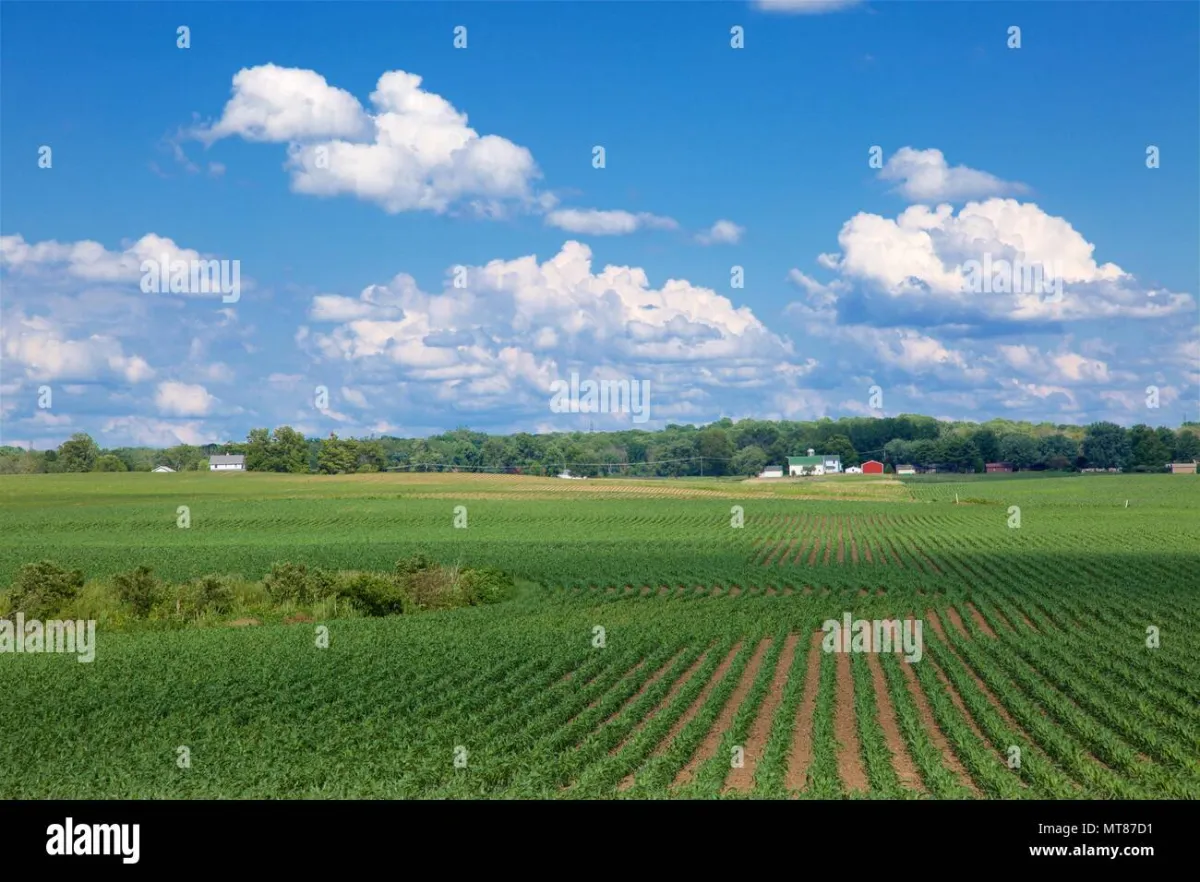 Photo: rural Midwest, via c8.alamy.com
The transition to private lines was celebrated as progress — and in many respects it was. But it also quietly severed something. The informal information networks that party lines had sustained didn't transfer to private lines. The accidental community connections that came from a shared circuit didn't survive the upgrade. People got privacy, and they lost something harder to name.
What It Looks Like From Here
Today, Americans communicate through encrypted messaging apps, private DMs, and personal devices that are designed from the ground up to keep conversations contained. The pendulum has swung about as far from the party line as it's possible to go. Your neighbor doesn't know you're on the phone. Your community doesn't hear your news until you choose to share it, in the format you choose, on the platform you choose.
There's a version of this story where that's pure gain — autonomy, security, control over your own information. And that version isn't wrong.
But there's another version where something genuinely communal got traded away in the name of privacy, and where the isolation that characterizes so much of modern American life has roots that run deeper than social media algorithms and suburban sprawl. The party line wasn't just a telephone arrangement. It was a technology that made community almost impossible to avoid.
Now community requires effort, intention, and a deliberate choice to reach out. The wire that once connected a dozen households to each other has been replaced by a dozen separate wires, each going exactly where it's told and nowhere else.
The neighborhood is still out there. It just stopped calling.