Sorry, We're Closed: The Era When Everything You Wanted to Know Had to Wait Until Morning
It's 9:47 on a Tuesday night. You're planning a road trip and you want to know the best route through the Smoky Mountains. You want to know whether a certain campsite allows dogs. You want to understand the difference between two national parks you're considering. You want to read reviews, check weather patterns, look at elevation maps.
So you pick up your phone and you know all of it within four minutes.
Now go back to 1988. Same Tuesday. Same questions. The library closed at six. The bookstore is shut. The travel agent's office won't open until nine tomorrow morning. Whatever you know right now, that's what you're working with. The curiosity that's buzzing in your brain is going to have to wait.
This was the reality for most of American history, and it shaped not just how people learned things, but whether they learned things at all.
The Library Was the Internet — With Worse Hours
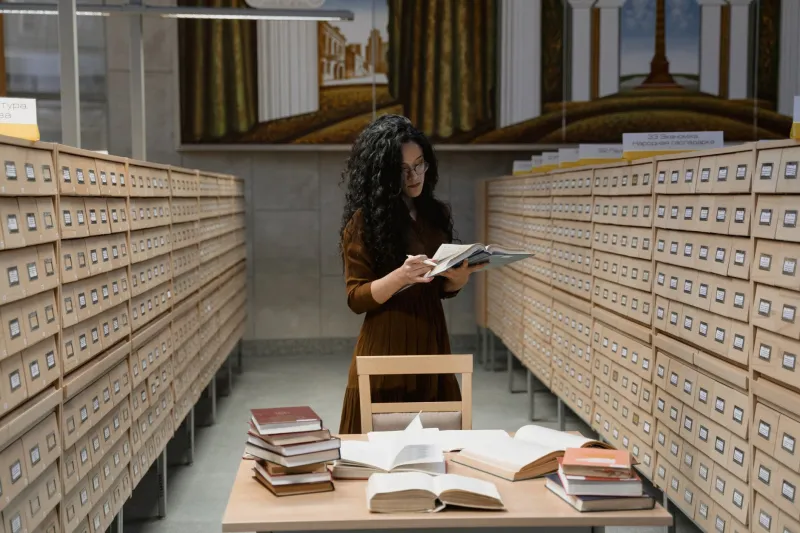
For most of the 20th century, the public library was the closest thing America had to a democratized information network. It was free. It was open to everyone. And within its walls, you could find answers to an extraordinary range of questions — if you knew how to navigate the card catalog, if you could find the right reference book, and if you arrived before closing time.
That last condition was the one that caught people most often.
Public libraries in the mid-20th century typically kept hours that mirrored the working day: open by nine, closed by eight or nine on weeknights, shorter hours on Saturdays, and often completely shut on Sundays. For families where both parents worked, or for students who had after-school commitments, the window to access information was genuinely narrow.
And when you got there, the research itself took time. Finding a book on the shelf was step one. Finding the relevant section within the book was step two. Cross-referencing with another source was step three. A research session that today would take eight minutes could easily consume an entire Saturday afternoon.
The Questions That Just Went Unanswered
Here's what's easy to underestimate: how many questions simply died without answers. Not because people weren't curious, but because the cost of satisfying that curiosity — the time, the travel, the scheduling — was sometimes higher than the payoff.
You'd wonder something at dinner and promise yourself you'd look it up. Then life would continue and you'd forget. Or you'd remember, but the library would be closed, and by the time it opened again the question had faded. Entire categories of idle intellectual curiosity just evaporated because the infrastructure for answering them wasn't available at the moment the question arose.
This wasn't a crisis. People lived full, rich, intellectually engaged lives. But there was a constant low-level friction between wanting to know something and actually knowing it that we've so thoroughly eliminated that it's almost hard to imagine now.
The Gatekeepers of Knowledge
Librarians, for all the warmth and genuine expertise many of them brought to the role, were also — structurally — gatekeepers. Not by design or intention, but by the nature of the system. If you didn't know how to use the Dewey Decimal system, you needed help. If the reference book you needed had been checked out, you were stuck. If your question was unusual or highly specific, you were at the mercy of whatever materials the library had chosen to acquire.
Geography mattered enormously. A public library in a well-funded suburb of Boston had resources that a rural county library in Mississippi simply couldn't match. The democratization of access that libraries represented was real — but it was partial, uneven, and bounded by walls and hours.
College students had it somewhat better, with university libraries that kept longer hours and held deeper collections. But those were gated communities of knowledge too — you generally needed a student ID to get in, let alone to check anything out.
The Night the Internet Changed Everything
The transition wasn't instantaneous. Dial-up internet in the mid-1990s was slow, expensive, and limited in what it could actually deliver. But even in those early days, something had fundamentally shifted. Information was starting to exist somewhere that wasn't a building with a closing time.
By the early 2000s, Google had made the experience fast enough to feel like thought itself — you had a question, you typed it, you had an answer. Wikipedia, for all its imperfections, put an encyclopedia's worth of information in front of anyone with a connection. And crucially, none of it required you to be anywhere at any particular time.
Today, the 24/7 availability of information is so normalized that its absence is unimaginable. Students research papers at midnight. Travelers plan routes at 3 a.m. Parents look up medication interactions in hospital waiting rooms. The question and the answer now exist in the same moment, regardless of the hour.
What the Closed Door Actually Did
There's a case — a genuinely interesting one — that the friction of the old system wasn't entirely without value. When research required effort, people thought harder about which questions were worth asking. When you had to travel somewhere to find an answer, you tended to stay and find a few more while you were there. The library visit was an event, and events have a way of sticking in memory.
There's also the question of depth. A librarian who helped you find something often pointed you toward three related things you hadn't thought to look for. The serendipity of browsing physical shelves — pulling out a book because the spine looked interesting, discovering an entire subject you'd never considered — is something that algorithmic search, for all its efficiency, doesn't reliably reproduce.
Knowledge with business hours was frustrating. It was also, in certain ways, more of an adventure.
The library door closing at six meant that whatever you discovered inside mattered enough to remember. You'd made an effort. You'd shown up. The information had cost you something, even if only an afternoon.
Now it costs nothing, which is mostly wonderful. Occasionally, though, on a quiet night when you've had seventeen browser tabs open for two hours and can't quite remember why you opened any of them, you might understand what that cost was actually buying.